Modeling phase equilibria of acetone – water – salt mixtures
\nLiquid-Liquid, Solid-Liquid, and Vapor-Liquid Equilibria in acetone water solutions with NaCl, Na2SO4, KCl, and K2SO4 were modeled using the Extended UNIQUAC model. Previous papers on the thermodynamic modeling of phase equilibria in acetone-water-salt solutions were limited to the modeling of vapor-liquid equilibrium.
\nAccording to the experimental data available in the open literature, solutions with K2SO4 do not split into two liquid phases and the lower consolute temperature of acetone water mixtures with KCl is 40 °C. The corresponding temperature for Na2SO4 solutions is reported to be 29.8 °C. For solutions with NaCl, liquid-liquid equilibrium was reported at temperatures down to 4 °C.
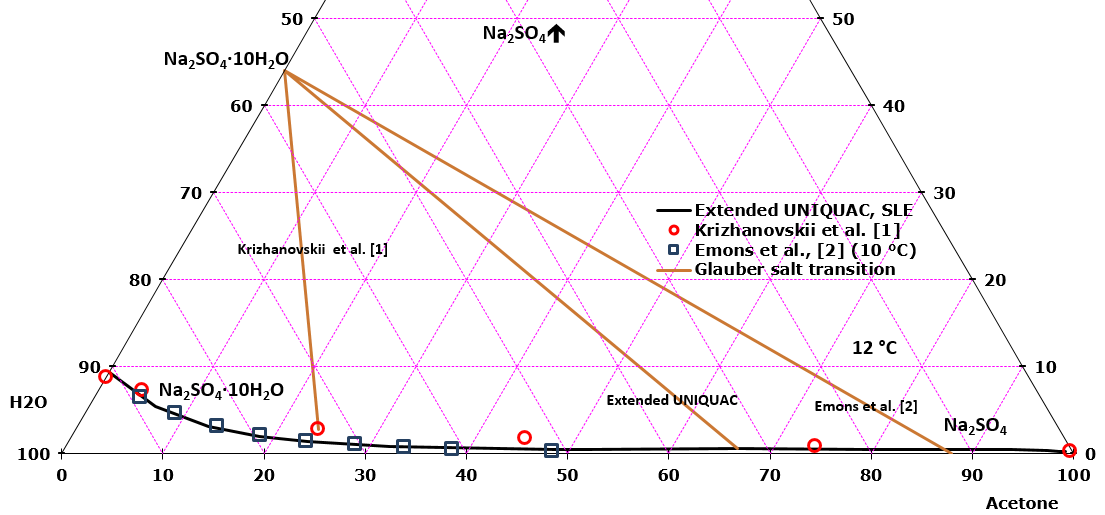
\nFigure 1 shows the experimental and calculated solid-liquid equilibrium curve in the Acetone-water-Na2SO4 system at 12 °C. With increasing acetone content, the water activity is lowered, resulting in anhydrous Na2SO4 becoming the stable solid phase rather than glauber salt, Na2SO4·10H2O. The acetone concentration required for this transition differs widely between the experimental studies available.
\n\n
\n
Figure 1: Experimental data and modeling result for solid-liquid equilibrium in the acetone-water-Na2SO4 system at 12 °C. The measured and calculated Na2SO4·10H2O/Na2SO4 transitions are marked.
\n\n
The modeling was performed with the Extended UNIQUAC model which combines a Debye-Hückel term with the UNIQUAC local composition model.
\nDiscrepancies between the reported experimental data for the system studied here is probably a contributing reason why the thermodynamic modeling of this system is more difficult than the modeling of similar systems containing alcohols instead of acetone.
\n\n
Keyword( italic bold): Mixed solvent; Acetone; Liquid-Liquid Equilibrium; Solid-Liquid Equilibrium; Vapor – Liquid Equilibrium
\nReferences
\n[1] A. B. Krizhanovskii, E. S. Nenno, R. M. Skripinchenko, Russ. J. Inorg. Chem., 17(1972)1322-1324 [2] H.-H. Emons, H.-U. Triebs, F. Winkler, Z. anorg. allgem. Chemie, 382(1971)1-8
X-ALT-DESC;FMTTYPE=text/html:Modeling phase equilibria of acetone – water – salt mixtures
\nLiquid-Liquid, Solid-Liquid, and Vapor-Liquid Equilibria in acetone water solutions with NaCl, Na2SO4, KCl, and K2SO4 were modeled using the Extended UNIQUAC model. Previous papers on the thermodynamic modeling of phase equilibria in acetone-water-salt solutions were limited to the modeling of vapor-liquid equilibrium.
\nAccording to the experimental data available in the open literature, solutions with K2SO4 do not split into two liquid phases and the lower consolute temperature of acetone water mixtures with KCl is 40 °C. The corresponding temperature for Na2SO4 solutions is reported to be 29.8 °C. For solutions with NaCl, liquid-liquid equilibrium was reported at temperatures down to 4 °C.
\nFigure 1 shows the experimental and calculated solid-liquid equilibrium curve in the Acetone-water-Na2SO4 system at 12 °C. With increasing acetone content, the water activity is lowered, resulting in anhydrous Na2SO4 becoming the stable solid phase rather than glauber salt, Na2SO4·10H2O. The acetone concentration required for this transition differs widely between the experimental studies available.
\n\n
\n
Figure 1: Experimental data and modeling result for solid-liquid equilibrium in the acetone-water-Na2SO4 system at 12 °C. The measured and calculated Na2SO4·10H2O/Na2SO4 transitions are marked.
\n\n
The modeling was performed with the Extended UNIQUAC model which combines a Debye-Hückel term with the UNIQUAC local composition model.
\nDiscrepancies between the reported experimental data for the system studied here is probably a contributing reason why the thermodynamic modeling of this system is more difficult than the modeling of similar systems containing alcohols instead of acetone.
\n\n
Keyword( italic bold): Mixed solvent; Acetone; Liquid-Liquid Equilibrium; Solid-Liquid Equilibrium; Vapor – Liquid Equilibrium
\nReferences
\n[1] A. B. Krizhanovskii, E. S. Nenno, R. M. Skripinchenko, Russ. J. Inorg. Chem., 17(1972)1322-1324 [2] H.-H. Emons, H.-U. Triebs, F. Winkler, Z. anorg. allgem. Chemie, 382(1971)1-8
URL:https://www.cere.dtu.dk/da/Calendar/2019/09/CERE-Seminar-by-Kaj-Thomsen DTSTAMP:20260815T205100Z UID:{7CC12D9B-8531-4C51-9A34-8BAF6EE7F38F}-20190926T070000Z-20190926T070000Z LOCATION: B229/003 END:VEVENT END:VCALENDAR