By Alikbar Roozshenas
Abstract Geological CO₂ sequestration (GCS) is a critical strategy for mitigating anthropogenic CO₂ emissions.
It involves tightly coupled multiphase flow, chemical reactions, geomechanics, and thermal effects across multiple spatial and temporal scales.
In reactive transport modeling, the first two processes are central, as they govern long‑term CO₂ trapping and the evolution of reservoir properties.
A reactive transport simulator integrates two main components: a flow module that computes saturation and pressure distributions, and a geochemical package for species consumption and production due to chemical reactions.
Developing such a multiphysics model requires coupling fluid flow, solute transport, and reaction equations into a unified simulator.
In this study, we develop a reactive transport simulator based on the global implicit method.
The simulator couples an in-house compositional reservoir simulator with a proprietary chemical-phase equilibrium (CPE) package.
The CPE module uses the modified RAND algorithm, as described by Paterson et al. (Paterson, 2019), to solve the chemical and phase equilibrium problem simultaneously by minimizing the Gibbs free energy.
This non-stoichiometric formulation enables fast and robust equilibrium calculations and is therefore well suited for large-scale reactive transport simulations. we additionally account for kinetic reactions and their time-dependent effects on porosity and permeability, allowing the model to represent the dynamic coupling between geochemical processes and evolving flow properties.
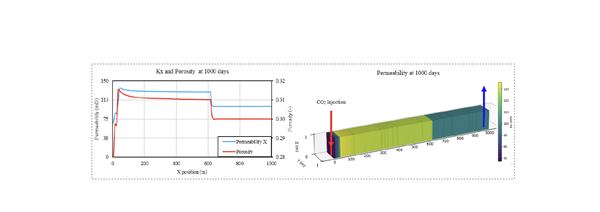
The following figure illustrates the porosity-permeability changes in a 1D CO2 injection into a formation initially in equilibrium with calcite.
References
[1] E. Ahusborde, B. Amaziane, and M. El Ossmani, “Improvement of numerical approximation of coupled multiphase multicomponent flow with reactive geochemical transport in porous media,” Oil & Gas Science and Technology–Revue d’IFP Energies nouvelles, vol. 73, p. 73, 2018.